A Prayer for the Crown-Shy by Becky Chambers

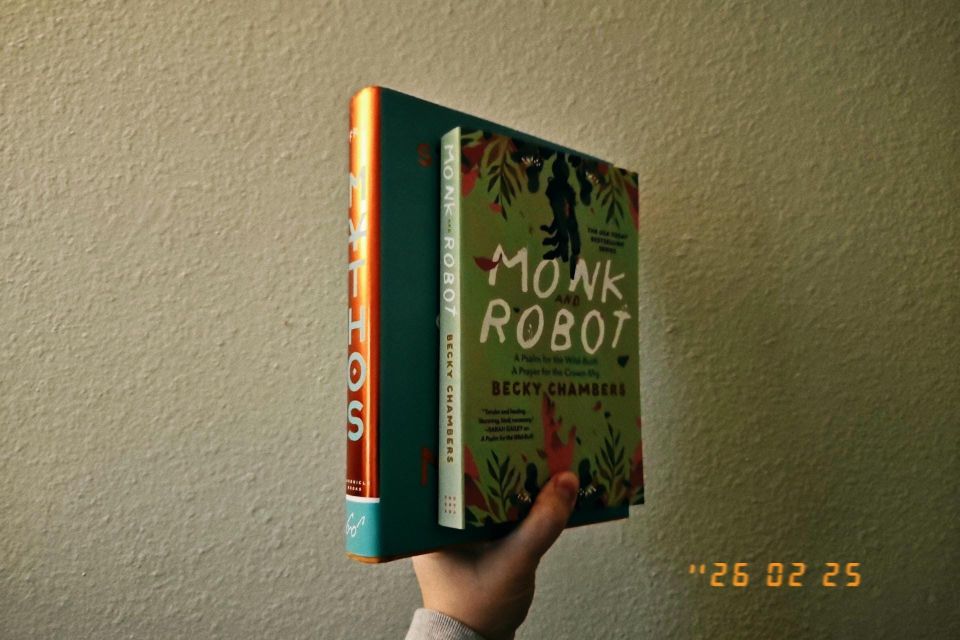
A Prayer for the Crown-Shy is the second book in Becky Chambers’ Monk and Robot duology, which begins with A Psalm for the Wild-Built. I loved both books, and finishing this one left me with the same feeling I had at the end of the first: peace and satisfaction.
I would describe these books as solarpunk. It shows what a society might look like if it learned to live with technology without abusing it. The robots in this world became sentient and eventually chose to leave humanity altogether, retreating into the wilderness rather than dominating or serving humans.
That being said, the books aren't really about the robots. They’re about people trying to understand what it means to live a good life.
These books do an excellent job of asking big questions with as little pressure as possible. They don’t ask the reader to do the heavy lifting. Instead, they take you by the hand and guide you through conversations and experiences that feel adjacent to your own life. Watching the characters think through things feels a bit like watching yourself intellectualize your own existence.
A personal example of this is when Dex, the tea monk, starts to explore their feelings about doing tea service. Dex used to find deep meaning and joy in serving tea to others, but at some point, the exchange stopped feeling even. They left the work, but the question lingered: if you’re good at something that benefits people, do you owe it to the world to keep doing it?
That question resonated with me because I taught yoga and meditation for about twenty years. For a long time, it felt like my purpose in life. I believed I was contributing to my community in a meaningful way. But during the last several years of teaching, the relationship changed. The work no longer felt like an even exchange. Eventually, I stepped away from it.
I still miss it sometimes. But I also know that season of my life has passed.
Reading about Dex’s complicated feelings around tea service reminded me of that experience. Missing something doesn’t necessarily mean you should return to it. Sometimes the work you once loved belongs to a previous version of yourself.
Another idea that surfaces throughout the book is the notion that simply existing might be enough. The tension isn’t about self-worth so much as it is about time. I don’t like the feeling of wasting it.
But my definition of “wasted time” has changed over the years. I used to think things like watching television was as wasting time. Now I see it differently. To me, wasted time is when you have the energy and desire to do something meaningful to you, and you choose not to act on it.
Lately, I’ve been writing almost every day. Even when I don’t feel particularly creative, I sit down and do the work. The act itself feels fulfilling. If I felt the urge to write and ignored it, that would feel like a waste.
The Monk and Robot books don’t offer neat answers to life’s bigger questions. Instead, they sit comfortably in the uncertainty of them. And somehow, by the time you close the book, that uncertainty feels less like a problem and more like part of the rhythm of being alive.
 Tordotcom

→ Get a Copy of A Prayer for the Crown-Shy
Shop Independent Book Seller - https://bookshop.org/a/94915/9781250386335
Shop Used Books - https://www.thriftbooks.com
Shop Amazon (none of us want to, but we all do) - https://amzn.to/3PbyWQC
Shopping at Bookshop.org and Amazon.com with affiliate links puts a little money in my book-buying fund. I am eternally grateful.
Shopping at Thriftbooks.com gives old books new homes, and that's just good karma. The planet thanks you.
Member discussion